

In build · early access open
Good renting should
open doors.
TenantScore turns verified rental history into a score landlords can trust and renters actually own. Every point traces back to a real, sourced event — no anonymous reports, no black box, no permanent mark you can't challenge.
TenantScore is not live yet. Join the early-access list and we'll reach out before scoring opens in your state.
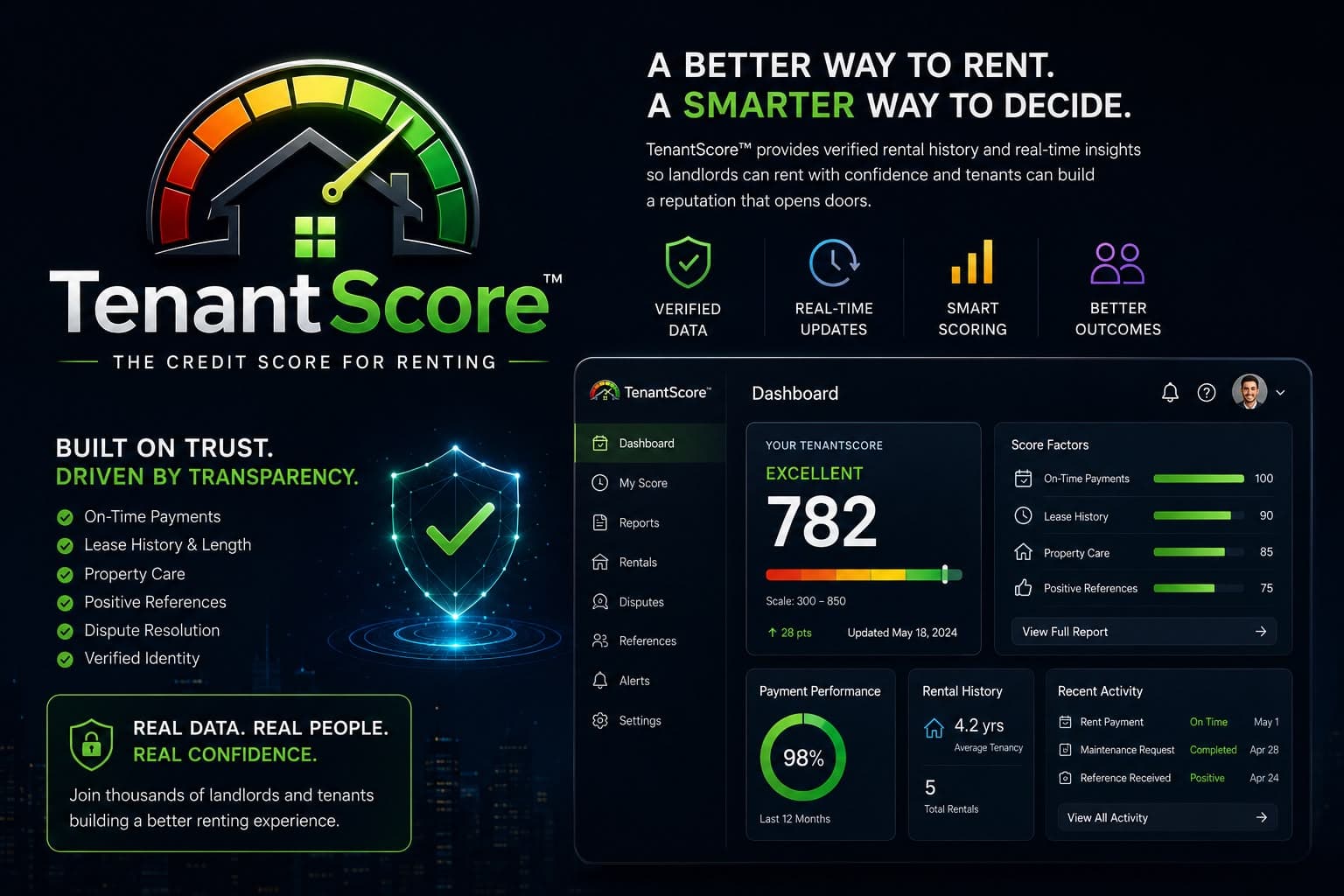
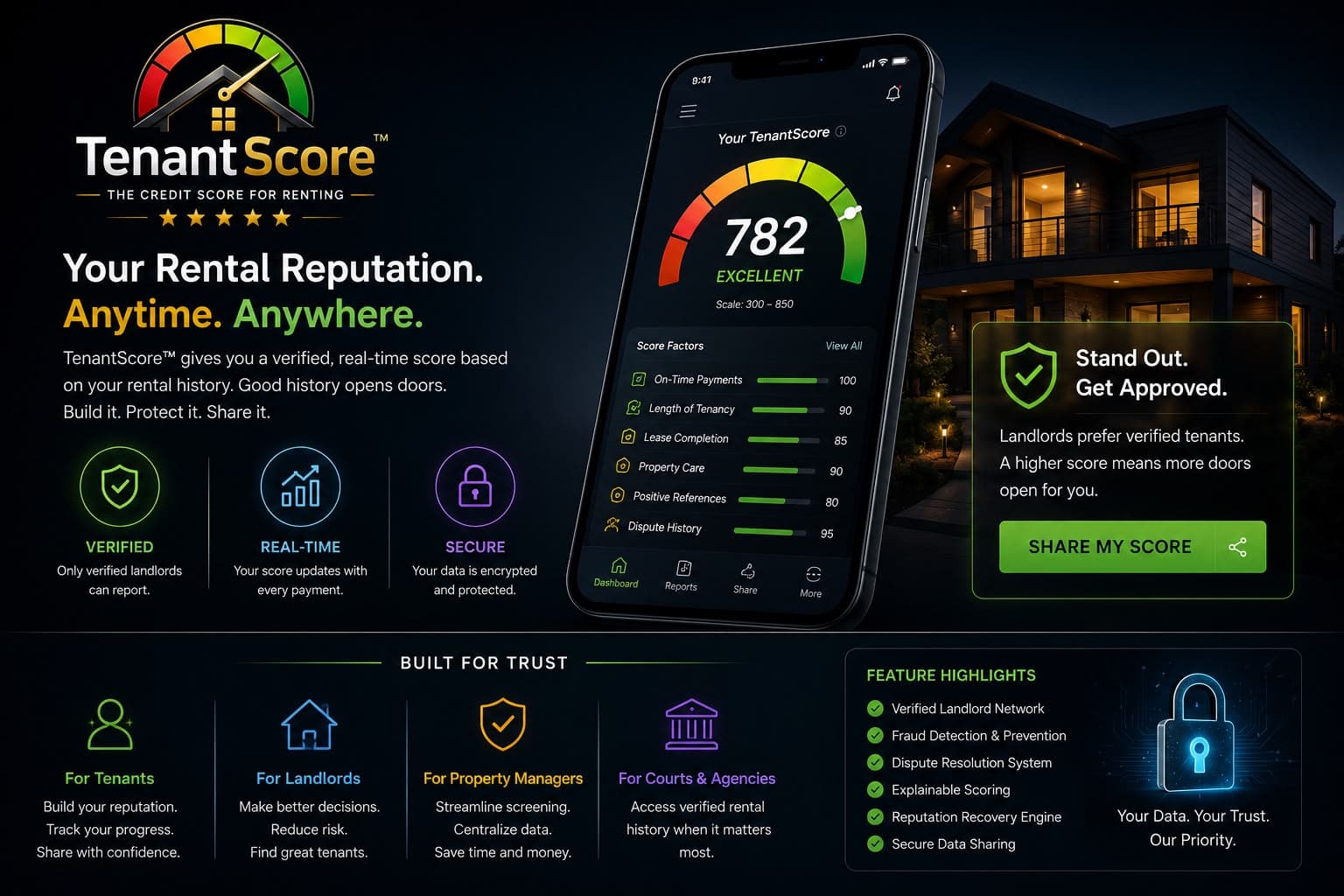
Your TenantScore
IllustrativeScore factors
- On-time payments100
- Length of tenancy90
- Lease completion85
- Property care90
- Positive references80
01What we score
Six things a landlord actually cares about — and nothing they shouldn't.
A TenantScore is built from rental behaviour, not from guesswork, gossip, or data scraped from somewhere you never agreed to. Each factor below carries a source, and every source is something both the renter and the landlord can see.
On-time payments
Rent paid on the day it was due — the heaviest signal in the file. Taken from a verified rent ledger, never from a landlord's recollection.
Source · Verified rent ledger
Lease history & length
Terms started, terms completed, and how long you stayed. A long, quiet tenancy is an achievement, and it should be worth saying out loud.
Source · Executed lease + tenancy record
Property care
Condition at move-out measured against condition at move-in, evidenced by dated documentation from both sides rather than one side's opinion.
Source · Move-in / move-out evidence
Positive references
Landlords can put something good on the record, not only something bad. Every reference is attributed to a verified organisation.
Source · Attributed landlord reference
Dispute resolution
How a disagreement was handled and whether it was resolved. A cured late payment is not the same thing as an open one, and it never reads that way.
Source · Reinvestigation outcome
Verified identity
The record belongs to the right person. Identity is matched before anything attaches to a file, so nobody inherits a stranger's history.
Source · Identity match on file
02How it works
Four steps. No mystery in any of them.
The whole method is short enough to print on a card. That is deliberate: a rental record only earns trust if both the person it describes and the person reading it can follow how it was made.
The rule underneath all of it
No score-changing fact without a source, a date, and an audit trail behind it.
- 01
Verify the tenancy
A landlord or property manager confirms the lease; the renter confirms it is theirs. Nothing enters a file that both sides haven't seen first.
Two-sided confirmation before any record exists
- 02
Build the payment record
Each month of rent becomes a dated, sourced event on the ledger — paid on time, paid late, or cured. Corrections create a new version; nothing is quietly rewritten.
Versioned records, never destructive edits
- 03
Score it, then explain it
The number arrives with reason codes in plain English: what moved it, in which direction, and what would move it back. No unexplained score, ever.
Every score ships with its reasons
- 04
Share on your terms
The renter chooses who sees the file and for how long. Access is permissioned, time-boxed, and logged — and it expires on its own.
Time-boxed access, full access history
03Two sides, one record
The same file reads differently depending on where you stand.
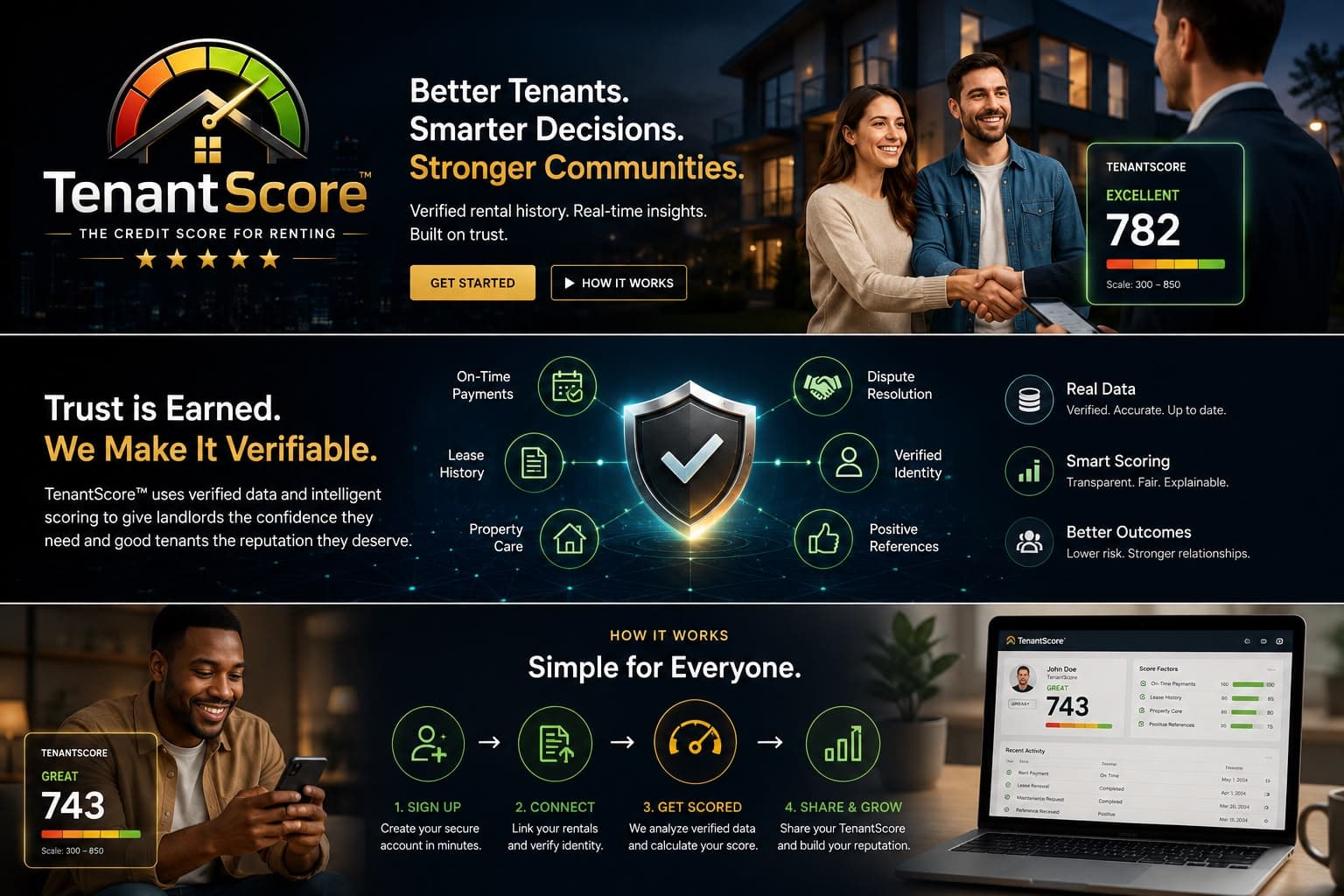
Screening today asks renters to prove themselves with paperwork they don't hold, and asks landlords to decide on references they can't verify. One shared, sourced record fixes both ends of that at once.
For tenants
Your rental history is an asset. Start holding the deed to it.
Paying rent on time for years currently builds you nothing. It should build the thing that decides whether you get the next apartment.

- Claim the history you already earned — the four quiet years nobody wrote down.
- See exactly which events moved your score, and by how much.
- Challenge anything you believe is wrong, with a real reinvestigation behind it.
- Share a current, verified profile instead of chasing old landlords for a reference.
For landlords
Stop deciding on a reference call you can't verify.
A vacancy costs more than a bad month of rent. Screen on evidence with a name and a date attached to it, and keep the residents worth keeping.
Reference call
“They were fine, I think.”
- Unverified source
- No dates
- No record afterwards
TenantScore file
48 of 48 months on time, two completed terms.
- Verified organisation
- Dated ledger events
- Full access trail
- Read verified tenancy and payment history instead of an unverifiable reference call.
- Report on your residents in minutes from the ledger you already keep.
- Reward good residents with a record that follows them — and helps you keep them.
- Decide from evidence you can point to, with an access trail you can stand behind.
For property managers
One reporting workflow across every property in the portfolio, with role-based access for on-site staff and a single audit trail for the whole book.
For courts & agencies
When rental history matters formally, it arrives sourced, dated, and versioned — with the correction history attached rather than quietly dropped.
04Built on evidence
A score is only worth as much as the record behind it.
We are building TenantScore the way financial infrastructure gets built — because a number that follows someone from apartment to apartment deserves that standard, whether or not anyone is watching.
Encrypted end to end
Data is encrypted in transit and at rest, identity fields are held separately from rental data, and access to either is logged. Secrets never live in the app.
Permissioned, not published
Nobody browses your file. A landlord sees it because you granted access for a stated purpose, for a set period — and you can see every time it was opened.
Sourced or it doesn't count
Every fact carries where it came from and when. Anonymous negative reporting isn't restricted here; it simply has no way to enter the system.
Disputes are the product
Challenging a record is a first-class workflow with deadlines and evidence, not a support ticket that ages out. Corrections create a new version and keep the old one.
Explainable by design
Nobody should have to guess why their number moved.
Every TenantScore comes with reason codes — a short, ranked list of what is helping and what is hurting, written in language a person can act on. If a factor can't be explained plainly, it doesn't belong in the score.
Reason codes
Illustrative
- PR-01436 consecutive on-time rent paymentsHelps
- TS-002Two lease terms completed in fullHelps
- RC-021Verified reference from current landlordHelps
- DL-108One late payment, cured within 14 daysHurts
05Straight answers
Questions we'd ask if we were you.
Is TenantScore live yet?
Not yet. We are building it now and opening early access ahead of launch. Join the list and we will contact you directly when scoring opens in your state — that is the only thing the list is used for.
Where does the data come from?
From verified landlords and property managers reporting on tenancies they can prove they hold, and from renters confirming those tenancies are theirs. Nothing is scraped, bought anonymously, or accepted without a traceable source.
Can a landlord report me without my knowledge?
No. A tenancy has to be confirmed by both sides before any record exists, and you are notified when a negative fact is proposed against your file. Anonymous negative reporting is not part of the design.
What happens if something on my file is wrong?
You dispute it. A dispute is a tracked case with deadlines, evidence, and a real reinvestigation behind it. If a record changes, the correction is versioned — the old entry is superseded, not erased, so the history stays honest in both directions.
Does a TenantScore affect my credit score?
No. A TenantScore is a separate rental reputation score. It uses a familiar 300–850 range so it is easy to read at a glance, but it is its own record and it lives on its own.
Who pays for it?
Renters will be able to claim and review their own file. Landlords, property managers, and agencies pay for screening reports and portfolio reporting. Final pricing will be published before launch.
06Get in touch
Get on the list before scoring opens.
Whether you rent, own, or manage on someone else's behalf, we want to hear what you need from a rental record before we finish building it. Every message goes to a person, not a queue.
By mail
PO Box 52Detroit, ME 04929
For written correspondence and documentation.
Response time
Within one business day
Early-access enquiries are answered in the order received.
Follow the build